 Diocese of Parañaque


The English word “saint” has assumed a very precise, technical meaning. We used it to describe a man, woman, or child – always deceased and usually long deceased – who has undergone the Church’s approval process known as canonization. We used it to describe someone who is, the Church authoritatively assures us, with God in heaven and capable of interceding for us on earth. It takes the Church decades or even centuries to arrive at such a decision. Along the way, the candidate’s life is subject to the most intensive scrutiny, examined by a variety of Vatican offices, as she or he moves from one honorific title to the next: SERVANT OF GOD-investigative phase. It is the title used in the documentation presented to the Vatican Congregation for the causes of the Saints. VENERABLE– indicates that the Church has conducted an initial examination of the candidate’s life and concluded that it is a life of “heroic virtue.” BLESSED is the title given when the Church has judged it “worthy of belief” that an individual is in heaven. The declaration usually comes after a miracle has been attributed to the candidate’s intercession. The ceremony declaring someone blessed is called beatification. SAINT appears before the names of those the Church has declared, with certainty, to be in heaven. Canonization is the act by which the pope recognizes someone as a Saint.
Today, the Universal Catholic Church celebrates the Solemnity of All Saints. The saints as the Book of revelation tells as are “a great multitude which no one could count.” Our celebration is actually much more of our benefit than for theirs. This is primarily for us, not for them. The word saint is translated in Latin as Sanctus, Hagios in Greek and Kodesh in Hebrew. In French for example, the word saint simply means Holy, and it may be applied to a person, place, or thing that is generally considered as sacred. In fact, before the coming of Christ, Holy was a word whose usage was bound in the most limited way. Strictly speaking, it was reserved for God alone. “There is none Holy like the Lord, there is none besides thee…’’(1 Samuel 2:2). Hebrew word “Kodesh’’ or Holy and its derivatives (like Kedushah or Holiness) are properly applied only to God. In the Hebrew scriptures, the word refers to God’s essence.
The word is used to describe the Almighty and then by the extension to describe God’s presence and the place or time of his dwelling. Like for example the “tabernacle’’ the portable shrine used by the Israelites for sacrificial worship, was Kodesh. Israel is holy because God has chosen to dwell among the chosen people, who collectively are his holy ones. The Ark of the covenant is holy because it is the place of his dwelling; the law is holy because it protects the purity of the sanctuary; even the priestly vestments are holy, because they are reserved for use in God’s presence. But no man at this time is so sanctified. No man is a saint. Noah is a just man. Moses is a man of God. David is a man after God’s own heart. There is only one instance when a human being is described as holy. Elisha is so described in a wealthy woman’s speculation “I perceived that this is a holy man of God…’’The situation of holiness changes rather drastically with the Gospels. In fact, what was exceptional in the Old Testament becomes the rule in the New Testament. Before Jesus is even conceived, the angel tells the Blessed Virgin Mary: “the child to be born will be called holy”. We see God drawing closer. No longer was he off in the distance. He was here in our midst. Jesus transgressed the boundaries set up to keep the unclean from the holy. In one rather remarkable run in Mathew’s Gospel, we see him touching a leper, a corpse/tomb and bleeding woman.
Jesus’ holiness must indeed have been communicable, for, upon the resurrection, the tombs also were opened, and many bodies of the saints who had fallen asleep were raised. By the end of Jesus’ ministry, many people had been sanctified had come to share somehow in God’s holiness. In a more intense practice of our love, we seek from the saints’ example in there way of life, fellowship in their communion, and help in their intercession.
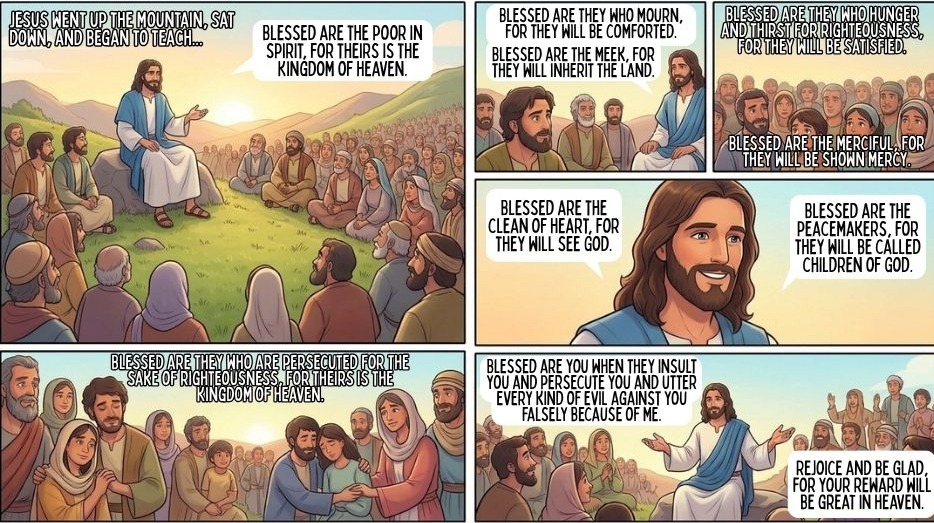
Our earthly life is made up of deeds freely chosen, for good or evil, and the deeds we chose will follow us to judgement. The deeds of the saints bear witness to their faith, for we are known by our fruits. The way of the Saints is the way of Christ. The way of Christ is the way of Beatitudes. As we commemorate the saints we are inflamed with another yearning: that Christ our life may also appear to us as He appeared to them and that we may one day share in His glory. Today, Jesus invites us to live the beatitudes – not merely to admire them but to practice them.
~ REV. FR. BRYAN MA. EALA, OSM
When I first read this Gospel, the verse that struck me the most was the last one, “Be glad and rejoice, for your reward is very great in heaven.” The thing that came to my mind was eternal life with God. Pero napaisip din ako, hindi naman natin basta-basta makakamit ang reward na iyon without going through the journey of faith, right? Then I came across another verse, ”Blessed are those who mourn, for they shall be comforted.” I remembered myself and all the times I mourned, not just because I lost someone, but because there were also moments when I almost lost myself too. I mourned for the things I knew I could do but, I felt like I could not. I mourned because I kept allowing other people to hurt me. I mourned for myself, for the version of me who was simply trying her best to keep going and live life despite everything. But life is really not that perfect. Kung si Hesus nga ay nakaranas ng mga hirap at hinanakit, ako pa kaya? I realized that God has always been there even in moments when I fail to recognize His presence. Minsan, hindi lang talaga natin Siya agad makita dahil masyado tayong nakatuon sa sakit na nararamdaman natin.
God has given us a promise, words that are not only meant to be heard but also understood and lived out. Bilang isang kabataan, aminado akong mahirap hanapin ang mga sagot sa mga tanong na gusto kong maintindihan. And perhaps, that is part of the journey I am experiencing right now as a servant of the Church. Along the way, there will always be pain, disappointments, frustrations, and failures. Oo, may mga pagkakataong sinasabi ko kay Lord, “Sana ganito, sana ganyan.” May mga panahon ding paulit-ulit akong naghahanap ng sagot sa mga tanong na mahirap unawain. But whenever I find myself in those moments, Siya pa rin ang nilalapitan ko. Hindi man lahat ng gusto ko ay nangyayari, I am still learning to trust that God sees things beyond what I can understand. Minsan, naiisip ko na baka ang mga pagsubok na pinagdaraanan ko ay paraan upang mas mapalalim ang aking pananampalataya at matutuhan kong kumapit sa Kanya, kahit hindi ko alam kung saan ako dadalhin ng sitwasyon. And with every pain, disappointment, and frustration that I carry, I realize that I can always turn to Him—not because He will immediately take away all my problems, but because I know I do not have to face them alone.
This Gospel reminds me that being blessed does not mean having life free from pain, struggles, and disappointments. Being blessed means having the courage to keep going despite something is wrong, the humility to admit that I cannot do everything on my own, and the faith and trust in God even when His plans do not align with mine. Hindi ko man lubos na nauunawaan ang lahat ng nangyayari sa buhay ko, I want to believe that there is a purpose in every experience, even in those moments that hurt me the most. I am still learning, growing, and trying to become the person God wants me to be. And maybe, that is what makes this journey meaningful—that I continue to seek Him even when I have questions. I know that I have a lot to work on but I pray that I will never lose the desire to serve Him, love others, and remain faithful despite the challenges I encounter. Because in the end, the greatest reward is not simply reaching heaven, but also learning to love, trust, and walk with God throughout this life, until the day I can finally be with Him.
~ MARDIN
PRAYER TO START THE WEEK
Lord Jesus, teach us to live the Beatitudes with humble hearts, gentle spirits, and a sincere love for others. Give us the courage to choose what is right, to show mercy, and to bring peace wherever we go. When we face difficulties or rejection because of our faith, remind us that our true happiness is found in You. May our lives reflect Your goodness and lead others closer to Your Kingdom. Amen.
Originally published in the Neo Jeremiah Voice of the Young Prophet Newsletter (November 01, 2026 issue).