 Diocese of Parañaque

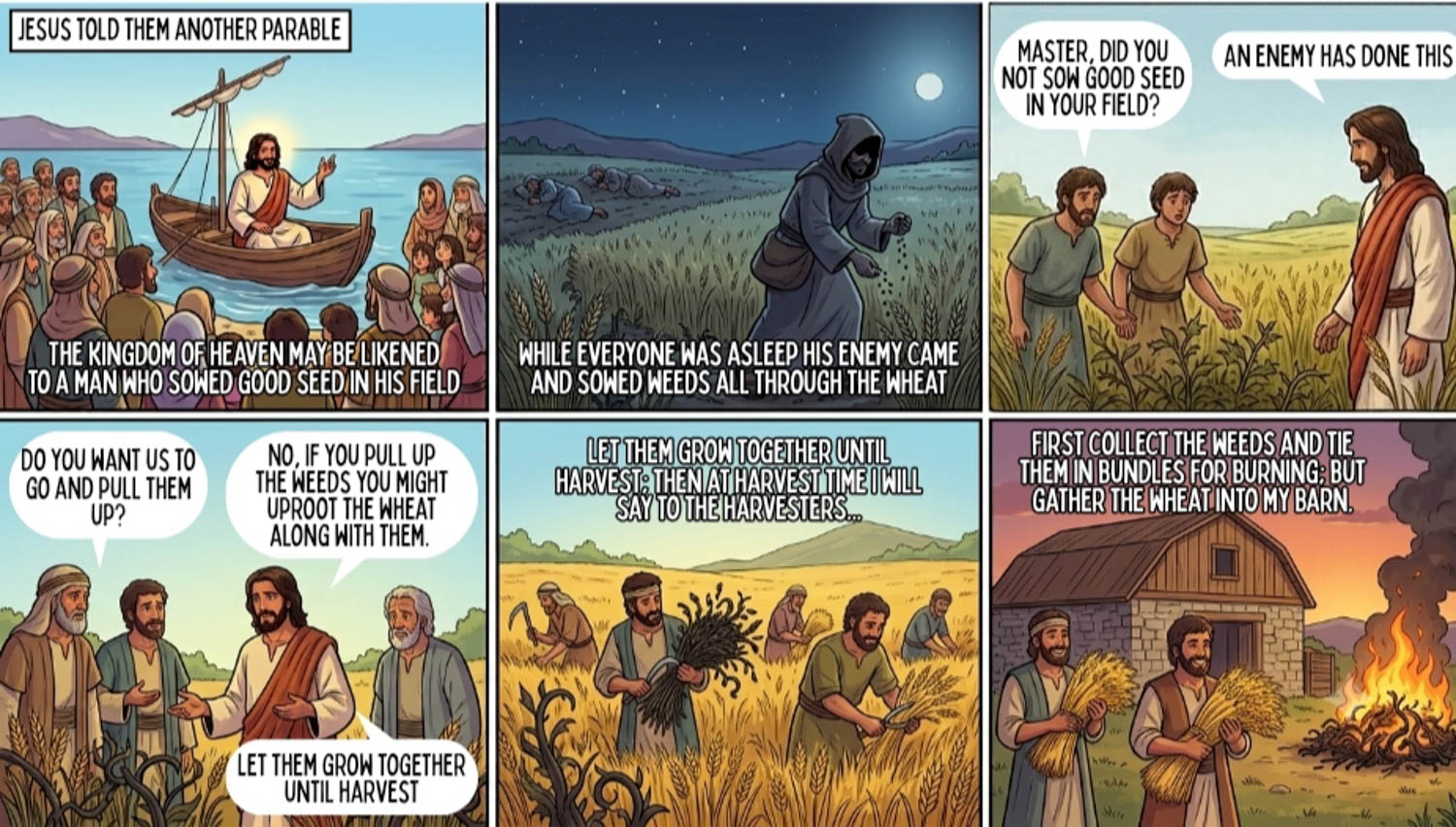
In Jesus’ ministry, apart from healing and exorcism, preaching is primarily the highlight of his proclamation of the coming of the Kingdom of God. Unlike the Pharisees and the Scribes who usually explain the words of God from the Law of Moses in a way that is in the level of the priestly understanding, Jesus made his preaching through parables. The stories of parables served as both a captivating teaching tool to make abstract ideas relatable and indeed a filter that required listeners to actively seek understanding. In other words Jesus uses ordinary day to day experiences of a simple Jew who is working like fishing and planting. Jesus used concrete, everyday objects like seeds, sheep, coins, and feast to portray complex intangible realities about God’s Kingdom. Indeed, this made his teaching memorable and easy for ordinary people to understand. That is why people from all walk of life wanted to listen to his preaching.
In our Gospel reading, St. Matthew presents three parables in cultivating and harvesting Gods word. The first parable is the parable of the weeds among the Wheat (Mt.13:24-30). The second is the parable of the mustard seed (Mt.13:31-32) and the third is the parable of yeast (Mt. 13:33). All these three parables was explain by Jesus as his disciples approach him as the crowds was dismissed. What are the lessons we can learn from the three parables. First, patience and tolerance in a world where good and evil co exists. Second, that there is a final judgment that awaits for all of us. The judgment of God alone can eliminate the sinful. Until then there must be patience of repentance. Third, that Gods mercy and forbearance in time in-between. Indeed, the parables of the mustard seed and the yeast illustrate the same point: the amazing contrast between the small beginnings of the kingdom and its marvelous expansion.
~ REV. FR. KRISTOFFER JOEY MA. OMANDAM, OSM
Growing in God’s Time
There are moments when I look at the world and wonder why God allows so much darkness to remain. I see broken relationships, injustice, pride, hatred, and suffering, and I quietly ask why He does not simply remove everything that wounds His children. Sometimes it feels as though the weeds have grown taller than the wheat, making it difficult to recognize the goodness that still exists. Yet in this Gospel, Jesus reveals a God whose wisdom is far greater than my impatience. He knows every heart more thoroughly than I ever could, and He understands that even the most hardened soul is never beyond the reach of His grace. His patience is not a sign of weakness or indifference. It is the patient love of a Father who refuses to abandon His children while there is still hope for repentance and healing.
As I think about these parables, I realize how often I measure growth by what is immediate and visible. I want quick answers to my prayers and clear signs that God is working. Yet Jesus reminds me that the Kingdom of Heaven often grows quietly and gradually. It begins like a tiny mustard seed that seems too small to matter and spreads like yeast hidden within the dough, quietly transforming everything from the inside. Perhaps this is how God is working in my own life. Every prayer offered in silence, every difficult decision to forgive, every moment I choose kindness instead of resentment, and every small act of faithfulness that no one else notices becomes part of the silent unfolding of God’s plan. He is teaching me that holiness is often formed in ordinary days, in unseen sacrifices, and in countless little choices to trust Him. The harvest may not be visible today, but God never wastes a single seed planted in faith.
This Gospel fills my heart with hope because it reminds me that God has never grown tired of me. He has remained patient through my failures, doubts, fears, and the many times I have wandered from His path. If God has shown me such faithful and patient mercy, then I know I am called to reflect that same mercy in the way I treat others. I want to be slower to judge, quicker to forgive, and more willing to believe that people can change through the grace of God. Rather than becoming discouraged by the weeds I see around me, I want to focus on becoming good wheat that bears fruit for His Kingdom. I pray for the patience to trust God’s timing, even when I do not understand His ways. Above all, I pray that my life may become a quiet witness to the truth that God is always at work, patiently cultivating every hearts that is willing to let Him in. One day, when the harvest is complete, I hope to look back and see that every small act of faith and every moment of trust was lovingly gathered by the Divine Gardener, who never stopped believing that something beautiful could grow within me.
~ LINN
PRAYER TO START THE WEEK
Heavenly Father, teach us to trust Your timing and to grow faithfully in Your love each day. Help us to be patient with others as You are patient with us, and let our lives bear fruit for Your Kingdom. Amen.
Originally published in the Neo Jeremiah Voice of the Young Prophet Newsletter (July 19, 2026 issue).