 Diocese of Parañaque

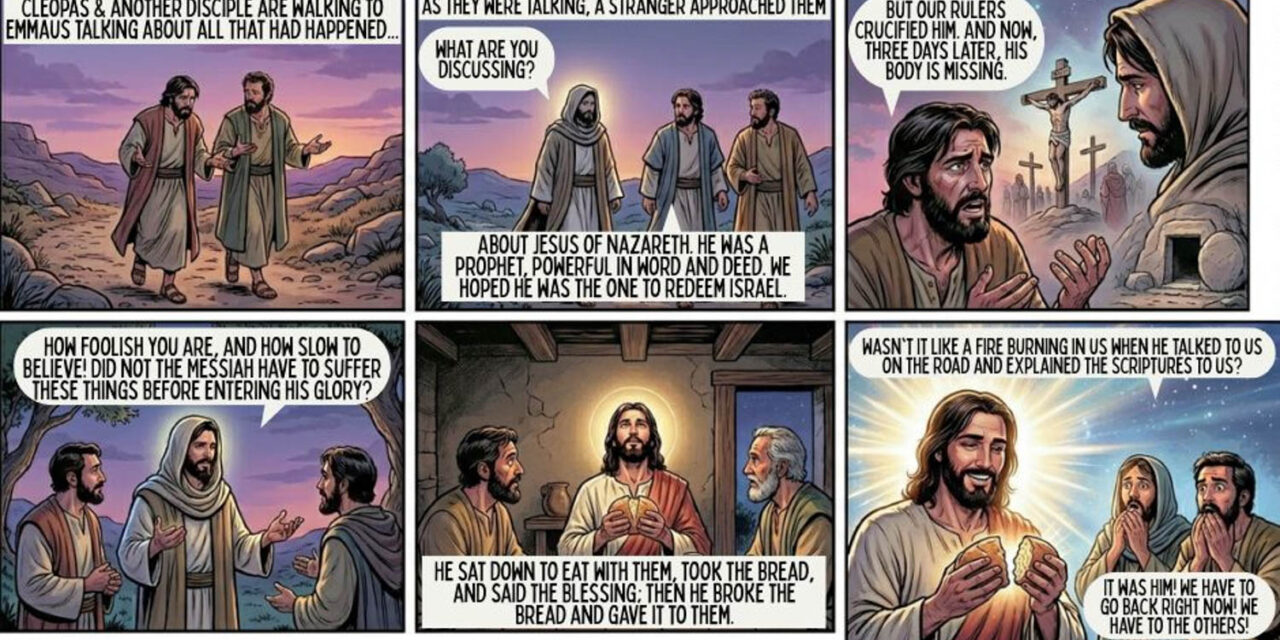
We are now on the Third Sunday of Easter. The narrative of this Sunday’s Gospel is a continuation of the resurrection story, where Christ had a series of appearances to his disciples. This time, we are being brought to a slightly distant place from where the events of Holy Week transpired, specifically to Emmaus. The two disciples—one was named Cleopas—were having an intense conversation on the recent happenings in Jerusalem. Jesus, who was by this time already resurrected, “drew near and walked with them” and even joined in their conversation. The Gospel notes that the eyes of the two disciples were prevented from recognizing Jesus. After they recounted to him a mixture of tragedy and wonder (here, they were actually speaking of the death and the alleged resurrection of Jesus), Jesus then began to clarify and explain everything that pertains to himself in the Scriptures. The passage goes on to narrate that later on, they invited Jesus to stay and eat with them, where they finally recognized him when they saw his actions on the bread they were going to eat: he took it, blessed and broke it, he gave it to them. He then almost immediately vanished from their sight.
There are three actions of Jesus that are worth noting in this Gospel:
1) As the WAY: He drew near his disciples and walked with them;
2) As the TRUTH: He explained to them the Scriptures and;
3) As the LIFE: He broke bread with them.
This gradual process of revealing himself after his resurrection is significant for us because we are able to see here a Lord and Master who takes the first initiative of bringing himself close to us despite his glory and divinity. This humble action of Christ who comes to us and walks with us reminds us of God’s own constant “descent” among us that he may be able to “take us up” to himself. By explaining the Scriptures to his disciples, it was as if he was actually telling them, “I am the one being spoken of by the prophets, the psalmists, the writers and scribes of the Holy Scriptures… by this time it should be obvious to you already.” The breaking of bread, which Christ has now made into his own Eucharist so that all may be nourished, is the ultimate act of self-reveal that makes Christ visible and recognizable in the midst of the chaos and gloom of the world. The disciples’ journey on the Road to Emmaus is also our own. We are exhorted to constantly abide by him and his teachings. We are invited to open our hearts and minds so as to be enlightened by his saving Word. The experience of encountering the Word of God leads us to say like the disciples: “Were not our hearts burning within us while he spoke to us on the way and opened the Scriptures to us?” We are also called to partake of him in the Holy Eucharist where he is truly present—Body, Blood, Soul and Divinity. May the story of Easter continue to give us joy, hope and strength.
– FRA. ROBERT FRANCIS MA. DUCADO, OSM
I often find myself identifying with the disciples on the road to Emmaus, walking through the motions of life with a heart that feels heavy. They were discussing their faith without any real understanding because their hopes were dampened by the harsh realities of the world.
What moves me is that Jesus does not wait for them to be perfect. Instead, He simply joins their journey and explained the Scriptures, correcting them, and rekindling their hearts.
In the Liturgy of the Word, He does the same for us. He listens to our hidden grief and talks to us through the Scriptures, turning it into a moment of profound clarity as soon as we open our hearts. I have realized that the Word is not just old text. It is the Lord gently correcting our perspective and reminding us that He is moving even in our confusion, just like what He did with the disciples. Now, I invite you to look at the moment the journey moves from the road to the table. When the disciples asked the Lord to “stay with us,” their faith moved from a vague idea to a physical encounter.
It was in the sacred actions of the Eucharist, specifically the taking, blessing, breaking, and giving of the bread, that their eyes were finally opened to His Real Presence.
If you feel your heart has grown lukewarm, consider what happens at the altar. Do you recognize that the same Jesus who walked the dusty road is truly present in the Blessed Eucharist? How might the truths you hear during the Gospel prepare you to encounter Him in the Bread?
In the Mass, Word and Eucharist are so tightly bound that we cannot have one without the other. In those moments when you feel confused and uncertain, will you allow yourself to be surprised by Him at the table where He waits to be recognized and received?
– Bro. Alvin
PRAYER TO START THE WEEK
Dear Lord, thank You for always walking beside us, even when we feel lost, sad, or confused. Help us to recognize Your presence in our daily lives, in Your Word, and in the Eucharist. May our hearts burn with faith and joy as we follow You each day. Amen.
Originally published in the Neo Jeremiah Voice of the Young Prophet (April 19, 2026 issue).