 Diocese of Parañaque

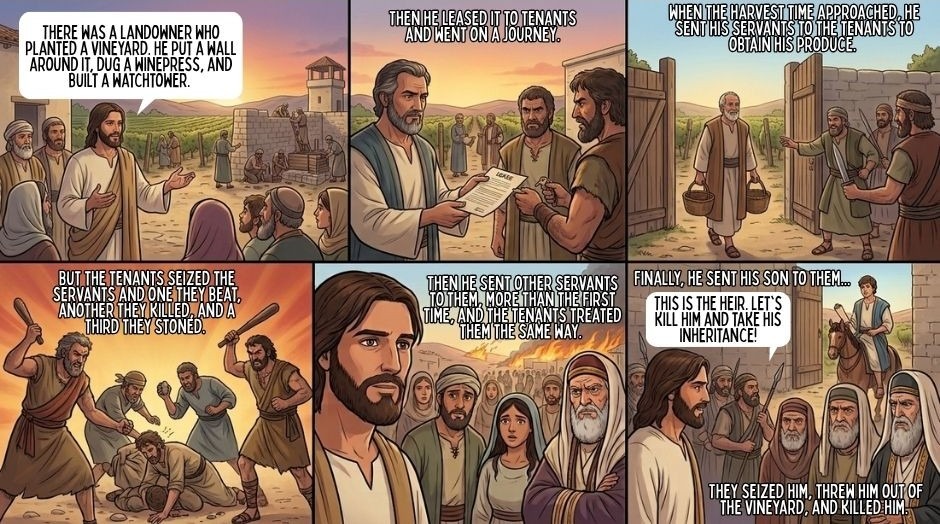
Matthew 21:33–43, commonly known as the Parable of the Wicked Tenants, is a pivotal allegory delivered by Jesus in the Temple during Holy Week. Delivered directly to the chief priests and elders, the passage addresses covenant betrayal, rejection, and divine judgment.
PARABLE ALLEGORY
| Allegory / Symbol | Meaning |
|---|---|
| Landowner | God the Father |
| Vineyard | Israel |
| Wicked Tenants | Religious Leaders |
| Servants Sent | The Prophets |
| Beloved Son | Jesus Christ |
| Rejected Cornerstone | Christ’s Death & Resurrection |
The parable heavily draws on the Song of the Vineyard in Isaiah 5:1–7, establishing the legal and prophetic context. The detailed preparation—planting, building a fence, digging a winepress, and erecting a watchtower—signifies God’s thorough provision and protection for Israel.
When harvest time approaches, the landowner sends servants to collect his share of the yield. The tenants’ escalating violence—beating, killing, and stoning these messengers—mirrors Israel’s historical rejection and persecution of God’s prophets. The climax occurs when the owner sends his son, anticipating respect. Instead, driven by greed and a desire to seize the inheritance, the tenants cast the son out of the vineyard and murder him—a prophetic prefiguration of Jesus’ execution outside the city walls of Jerusalem.
The text provides a stark Christological revelation. Jesus explicitly distinguishes himself from the prophets. While the prophets were servants (douloi), Jesus is the uniquely beloved Son (huios) and divine heir. His citation of Psalm 118 affirms that His coming humiliation and death are not a defeat, but the fulfillment of divine prophecy. God reverses human rejection through the Resurrection, making Christ the foundational cornerstone of His Kingdom. The passage encapsulates the story of salvation history. Israel was entrusted with the stewardship of God’s covenant promises. God’s repeated sending of servants highlights His long-suffering patience toward His people. However, privilege without responsibility leads to judgment.
The tenants rejected and harmed those whom the owner sent. In our daily life, God may speak through Scripture, the Church, our superiors, parents, friends, community, or even through difficult experiences. A Christian heart must remain humble enough to listen, especially when the truth challenges our comfort.
The greatest problem of the tenants was that they wanted the vineyard for themselves. We can fall into the same temptation when we say, consciously or unconsciously, “This is my life; I will do whatever I want.” Christian discipleship begins when we recognize that our life is received from God and must ultimately be returned to Him through love and service.
~ REV. FR. PETER JOHN MA. UBANAN, OSM
When God Becomes My Cornerstone
“Ang batong itinakwil ng mga tagapagtayo ng bahay ang siyang naging batong panulukan.”
This verse stayed with me because it reminded me of the many moments when I questioned if I was really enough. There are times when I ask myself if I am doing things right, if I am actually helping, or if my efforts still have value when no one notices them. Sometimes, when my work is overlooked or when I am not chosen, I easily take it as a sign that maybe I am not needed.
But this Gospel reminded me that being overlooked by people does not mean being overlooked by God. The stone that was rejected by the builders became the cornerstone. It made me realize that my worth does not come from recognition, a position, or from being chosen by others. My worth comes from God.
I also realized how often I want to be fully prepared, strong, and capable before I say yes to something. I want to feel that I am “enough” before I serve. But God reminds me that He does not ask me to be perfect. He asks me to be willing. My weaknesses and uncertainties do not automatically make me incapable of being used by Him.
There will always be moments when doors close, plans change, and I am not chosen for something I hoped for. It may hurt, but I am learning that rejection is not always the end. Sometimes, it is God redirecting me toward where He needs me.
So I ask myself: “Kapag hindi ako napili, magiging faithful pa rin ba ako? Kapag hindi ako napansin, maglilingkod pa rin ba ako?”
I want my answer to be yes.
Because at the end of everything, Jesus is my cornerstone. I may not always know where I belong, but I trust that if I continue to build with Him, He will give my life and my service the purpose they are meant to have.
~ FRED
PRAYER TO START THE WEEK
Lord Jesus, help us remember that everything we have is a gift entrusted to us by God. Teach us to be faithful and
responsible stewards of the blessings, talents, and opportunities You give us. May we never take Your love for granted, but always choose to listen, trust, and follow Your ways. Make our lives fruitful so that, through our words and actions, we may give glory to God and share His love with others. Amen.
Originally published in the Neo Jeremiah Voice of the Young Prophet Newsletter (October 4, 2026 issue).