 Diocese of Parañaque

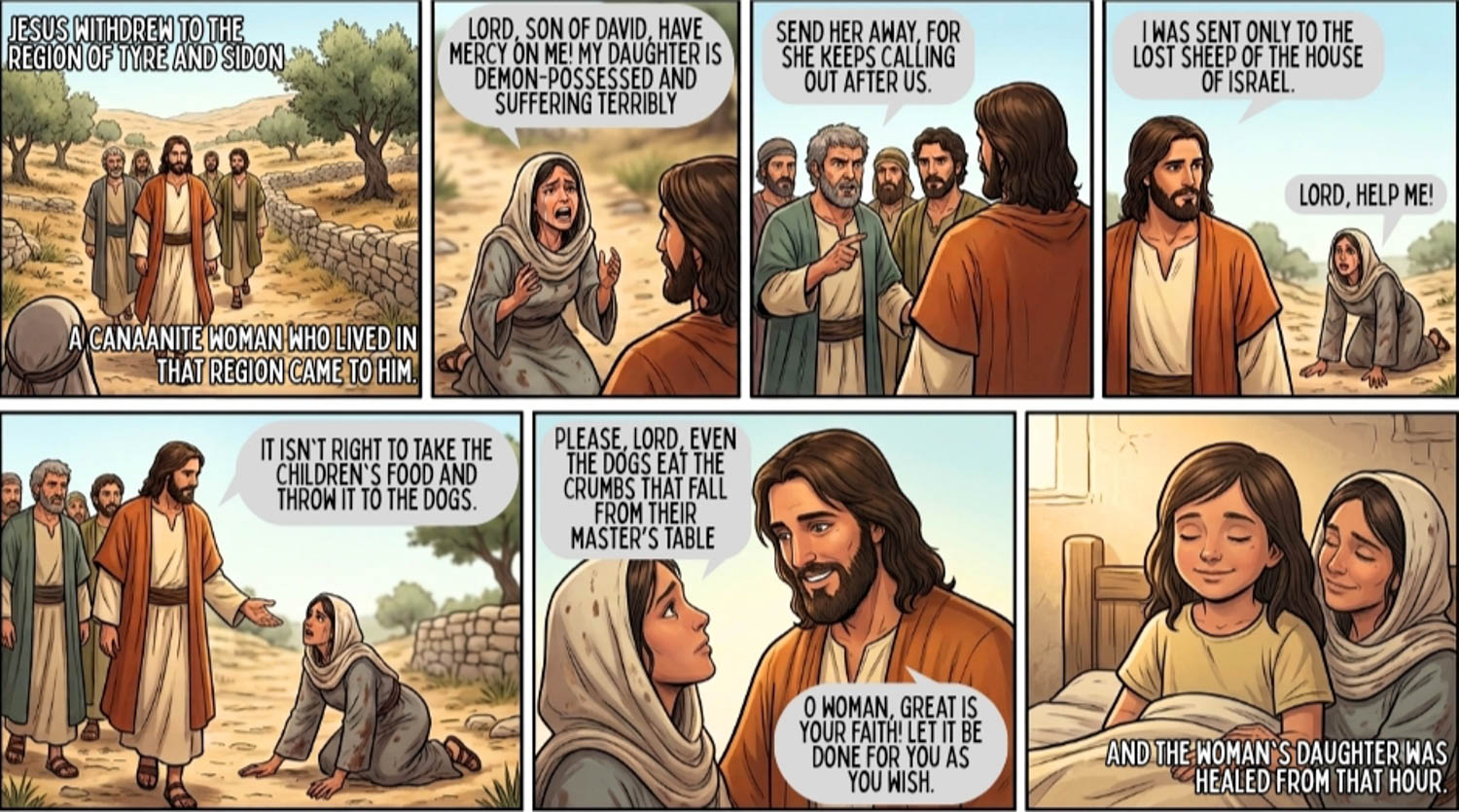
The encounter between Jesus and the Canaanite woman in Matthew 15:21-28 is one of the most challenging and most beautiful stories in the Gospels. At first it sounds harsh. Jesus withdraws to the region of Tyre and Sidon, Gentile territory, and a woman cries out, “Lord, Son of David, have mercy on me.” Yet Jesus does not answer. The disciples, annoyed, ask Him to send her away. Then comes the line that stops us: “I was sent only to the lost sheep of the house of Israel.” And finally, “It is not right to take the children’s bread and throw it to the dogs.”
But this is not a story about rejection. It is a story about faith being drawn out, tested, and crowned. The woman is called a Canaanite by Matthew, a name loaded with history. Canaanites were the ancient enemies of Israel. For a Canaanite woman to call Jesus “Son of David” and “Lord” is extraordinary. She sees what many in Israel do not yet see. Her daughter is tormented, and a mother’s love will not let her be silent. She cries out, she kneels, and she worships. Even in silence she persists.
Jesus’ apparent delay has a purpose. Throughout Matthew, faith is often revealed under pressure. The centurion had “great faith” because he trusted a word from a distance. Now a Gentile woman will show the same “great faith” because she trusts even when she receives no word at all. Jesus states the priority of His mission: to Israel first. He uses the common image of the time: children at the table, and little household dogs under it. He is not insulting her. He is inviting her to respond.
And her response is perfect theology spoken from the heart. “Yes, Lord, yet even the dogs eat the crumbs that fall from their masters’ table.” She does not argue. She does not take offense. She agrees with Jesus about Israel’s place, and then she trusts in the abundance of God’s mercy. If the children’s bread is so great, then even the crumbs are enough to heal. In that sentence she shows humility without despair, and boldness without pride. She believes that Jesus is so full of grace that a fragment of Him can restore a life.
Jesus immediately answers, “O woman, great is your faith! Let it be done for you as you desire.” And her daughter is healed instantly. Matthew wants us to notice something: the only two people in his Gospel praised for “great faith” are Gentiles — the centurion and this Canaanite woman. The Kingdom Jesus brings is not limited by bloodline or nationality. It is opened by faith.
For us today, this passage speaks to three realities. First, it speaks to seasons of silence. There are times when we pray and God seems not to answer. The temptation is to walk away. The woman teaches us to stay, to kneel, and to keep saying, “Lord, help me.” Second, it speaks to humility. She accepts the lowest place and finds herself exalted. God gives grace to the humble. Third, it speaks to the mission of the Church. Jesus did come first for Israel, but His mercy was always meant to overflow. The crumbs from His table are meant to feed the whole world.
This Canaanite mother reminds us that faith is persistent, humble, and confident in God’s goodness. She asked for a crumb and received the whole Christ. May we approach Him with the same trust: that even the smallest touch of His mercy is enough to heal our homes, our hearts, and our world.
~ REV. VIRGILIO MA. SULTAN, OSM
Even When I Feel Unworthy
What makes the Canaanite woman’s faith so inspiring to me is that she had the courage to approach Jesus even when she seemed to have no place among His people. She was a Canaanite, a Gentile, and not part of the people of Israel, yet she still recognized Jesus as Lord and placed her hope in Him. She could have told herself, “Maybe Jesus is not for someone like me,” but instead, she stepped forward and asked for His mercy. That makes me think about the moments when I feel unworthy to approach God because of my mistakes and weaknesses. Sometimes I create this distance between myself and Jesus because I think I need to become better first. But this woman reminds me that faith begins when I choose to come to Jesus even before I feel deserving of His mercy.
What makes her faith even greater is that she did not give up when the answer did not come immediately. She could have walked away disappointed, especially when she seemed to be receiving rejection, but she continued to trust and plead for mercy. Her persistence makes me look at my own faith. How often do I pray when I need something, but lose heart when God does not answer according to my timing? How often do I mistake God’s silence for His absence? The Canaanite woman teaches me that faith is not only saying, “I believe in Jesus” when everything is going well, it is also remaining at His feet when I do not understand what He is doing. She continued to seek Jesus because she trusted that His mercy would never turn her away.
In the end, Jesus praises her faith, and that part of the Gospel continues to resonate with me. The woman who was considered an outsider became an example of faith for the whole Church. Her story reminds me that God does not measure people by the labels that separate us, insider or outsider, worthy or unworthy, strong or weak. He sees the heart that continues to seek Him. It challenges me not only to trust Jesus more but also to stop deciding who deserves to be close to God, because His mercy extends beyond the limits of my judgment. Like the Canaanite woman, I want to have a faith that keeps coming back to Jesus, even when I am unsure, even when I am waiting, and especially when I feel like I do not belong. Because sometimes the strongest faith is not the faith that has all the answers, but the faith that simply refuses to walk away from Jesus.
~ LINN
PRAYER TO START THE WEEK
Lord Jesus, like the Canaanite woman, teach us to approach You with a humble and persistent faith, trusting in Your mercy even when we do not understand Your ways. Help us to never let our weaknesses, failures, or feelings of unworthiness keep us from seeking You. May our faith remain steadfast, so that like her, we may always choose to place our hope in You. Amen
Originally published in the Neo Jeremiah Voice of the Young Prophet Newsletter (August 16, 2026 issue).