 Diocese of Parañaque

During his seminary years, a seminarian always believed it was entirely up to him, through his own efforts, to seek and find the Lord in his life. To him, his studies and all formation classes in seminary were simply his ways of searching for God. There came a time, however, when he felt deeply disheartened because the more, he tried on his own, the less he truly seemed to know the Lord. But as he surrendered himself more deeply to the mystery of the Lord’s life in religious life, bringing along all his questions and hopes, he gradually realized: everything begins with God’s initiative, and he was simply being invited to cooperate in knowing Him. Through God’s unmerited grace, the very questions and emptiness in his life became reasons to seek Him all the more. His desire to find God was itself already part of God’s own divine self -revelation. Even before he ever began to seek anything else, or to thirst for God’s existence, He was already ready to reveal who He truly is. The Lord already desires to be with us far more than we desire to know Him.
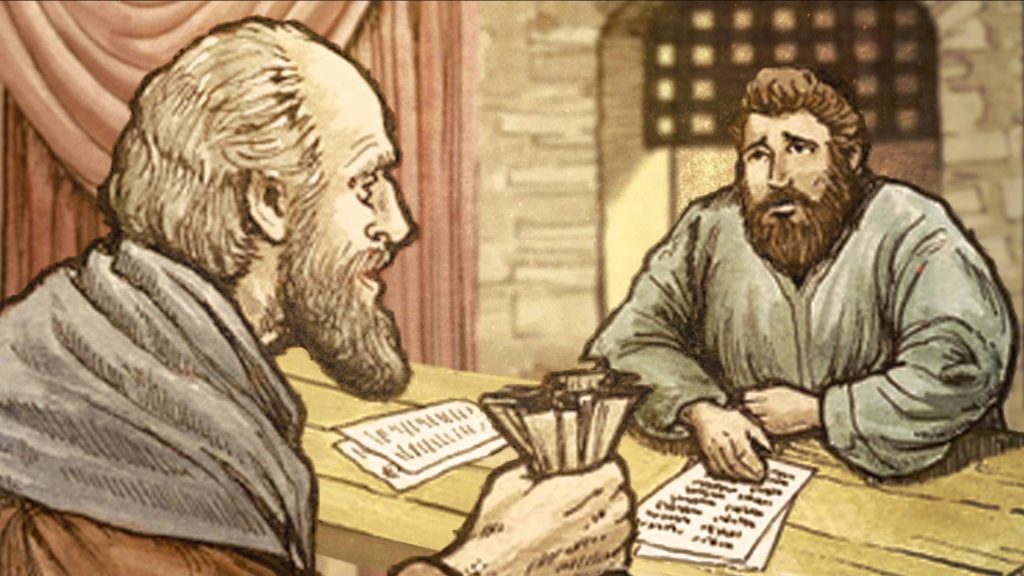
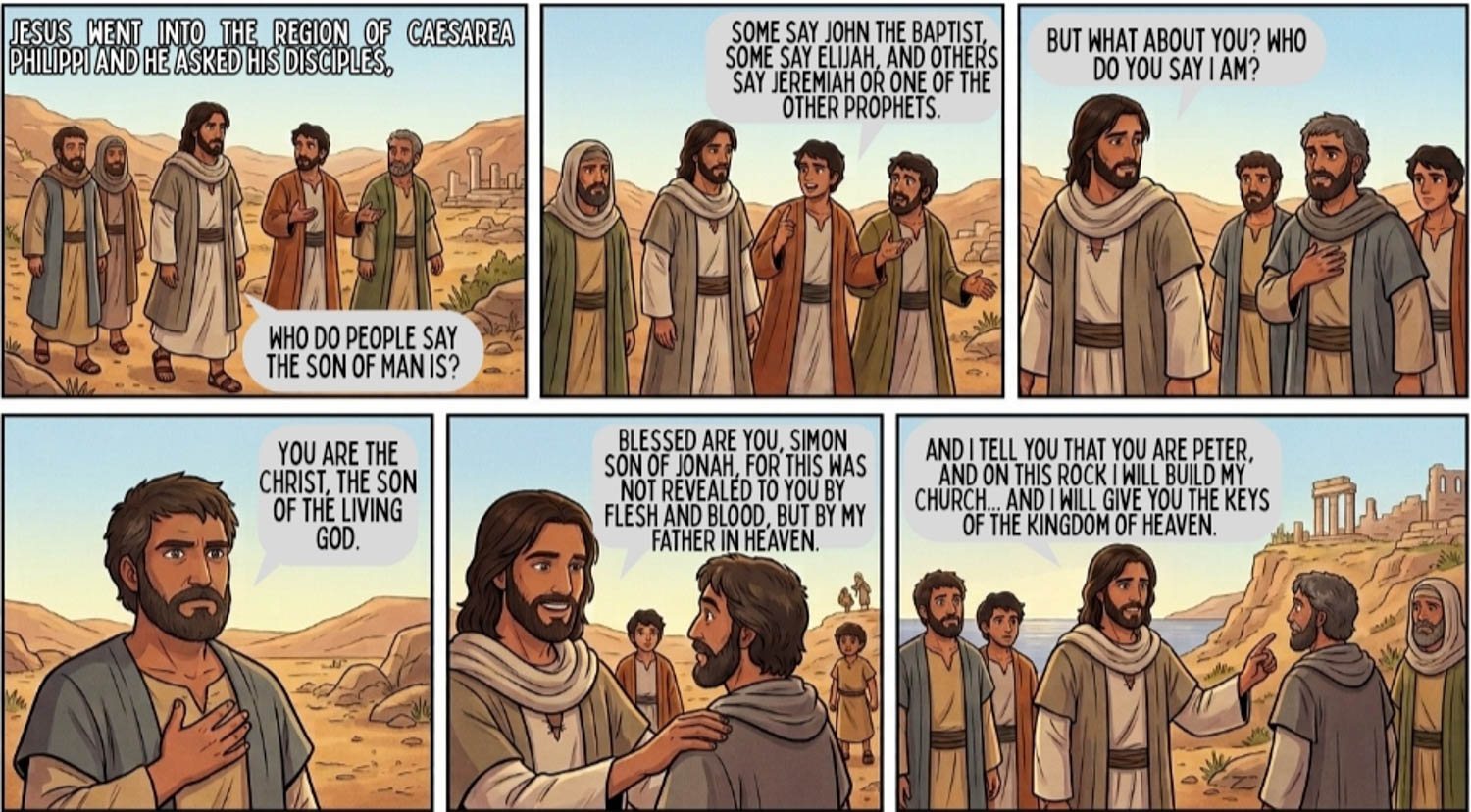
This truth has consoled me deeply after thirteen years in the seminary. I was already loved by Him long before I ever began to seek and love Him. How beautiful this is. It is also the Gospel’s reminder this Sunday, that genuine revelation comes from God Himself for those who sincerely seek Him. We may see ourselves in Peter, to whom Jesus said: “Blessed are you, Simon son of Jonah! For flesh and blood has not revealed this to you, but my Father in heaven.” Peter’s confession “You are the Messiah, the Son of the living God” was not the product of his human wisdom, or personal striving but it came directly from the Father. When Jesus spoke of “flesh and blood,” He meant this truth is a gift from above, not something we earn or figure out alone. With this revealed truth, each of us is invited into a personal encounter with Jesus, who asks us: “But who do you say that I am?” We may all have our own ideas of God based on experience, but we can look to Peter as our model. Peter was ordinary and imperfect yet open. Let us remember that revelation comes to the humble and quiet heart, not just the brilliant mind. Knowing Him is a gift revealed by the Father, a living bond and relationship. Even when we feel confused, lonely, or storm-tossed, God meets us in our simplicity and quietness. We need not be “someone great” for Him to reveal Himself but He chooses the ordinary to make Himself known.
May this revelation become our anchor in faith to follow and love Jesus. We continually ask the Holy Spirit to help us see beyond what our eyes and ears perceived so that we may remain strong, authentic, faithful, and joyful witnesses to the Gospel even in an uncertain world. Amen.
~ REV. JASPER MA. BANGUD, OSM
Ang aral ng Ebanghelyo ngayong Linggo ay patungkol sa pagpapahayag ni San Pedro Apostol ng kanyang pananampalataya at ang pangako ng Poong Hesus sa kanya.
Kinilala ni San Pedro ang tunay na katangian ni Hesus na ipinahayag sa kanya ng Diyos Ama. Sa pagsambit niya ng “Ikaw ang Kristo, na Anak ng Diyos na buháy”, ay hindi nangangahulugang Siya ay Anak ng Diyos Ama sa pangkaraniwang diwa. Bagkus, naniniwala si San Pedro na Siya ang Mesiyas, at Siya ay Diyos. At dahil sa kanyang pananampalataya, itinalaga siya ng Panginoon bilang una sa mga Apostol, at ang punong-guro at pinuno ng Kanyang Simbahan.
Sa Lumang Tipan, ang “Iglesya” (Church) ay nangangahulugan na isang kapulungan o pagtitipon ng mga Israelita. Sa pagbanggit ni Hesus sa Kanyang “Iglesya”, ang ibig sabihin Niya rito ay isang samahan ng mga taong nagkakaisa sa paglilingkod sa Diyos, ayon sa Kanyang mga ipinangaral sa kanila. Kung ihahalintulad sa isang gusali, sinasabing ito ay nakasalig sa bato kagaya ng bahay ng isang pantas o matalinong tao (Mateo 7:24). Si San Pedro ang bato, at ang katatagan ng haliging bato ng gusali—ang Iglesya—ay nagmumula kay Kristo—ang pinaka-pundasyon ng Simbahan (1 Corinto 3:11; Efeso 2:20).
Ang mga kaaway at mga masasamang kapangyarihang sumasagupa sa Simbahan, kasama ang kanilang lakas at mga kalupitan, ay hindi mananaig laban dito. Kailanman, sa buong kasaysayan ng Simbahan, ay hindi siya malulupig at hindi maguguho, sapagkat siya ay iniingatan at sinasamahan ng Panginoon hanggang sa wakas ng panahon; hindi Niya hahayaang manaig ang kamalian, at ipinagkatiwala rin Niya rito ang tungkuling mangaral sa daigdig (Mateo 28:16–20). Sa madaling salita, mananatiling tapat ang Simbahan sa mga katotohanang ipinahayag at itinuro ni Kristo, at hindi siya magkakamali sa mga bagay na kinakailangan para sa kanyang misyon at pananampalataya.
Mula kay San Pedro (ang unang Santo Papa) hanggang sa kasalukuyan, kay Papa Leon XIV (ang ika-267 na Santo Papa), mananatiling matatag, tunay, at buháy ang Inang Simbahan dahil ito ay: IISA dahil iisa lamang ang itinatag ni Kristo; BANAL, dahil ang Tagapagtatag at ang Kanyang mga turo ay banal; KATOLIKA (Pangkalahatan) dahil ang Kanyang Simbahan para sa lahat ng bayan at lahi; at APOSTOLIKA, dahil ito ay matutunton pabalik sa mga Apostol ni Hesus.
PANALANGIN:
O Hesukristong aming Panginoon at Mananakop (Tagapagligtas), kami ay nagpapasalamat sa Iyo, sapagka’t sa Iyong pag-akyat sa langit ay hindi mo pinabayaan ang Iyong Simbahan. Bagkus, ipinagkatiwala Mo ito sa iyong mga Apostol at sa kanilang mga naging kahalili, ang mga Santo Papa, na kumakatawan sa Iyo at nagsisilbing mga pastol ng mga kaluluwa dito sa lupa. Siya nawa.
~ G. BRYAN ACOSTA
“I will give you the keys of the kingdom of heaven.” I always wonder what the key means here. Is it something that is physically manifested, or is it something that is formed in the mind? Jesus says it figuratively. For every book in the Bible, it all comes from the single word “faith,” but why is that? Way back in the time of Moses, when he received the Ten Commandments, the first commandment states, “Thou shalt have no other gods before me,” which shows that we should have faith in Him. When Jesus was on His journey, He performed miracles through faith, and His wisdom came from His faith. You see, He left us with things that call us to have faith in Him, and I realized that the key to salvation is having faith in Him. That is what Jesus meant figuratively.
“Whatever you bind on earth will be bound in heaven, and whatever you loose on earth will be loosed in heaven.” As I said earlier, the thing that binds us on earth and will be bound in heaven is the faith we have. I remember the philosophy of the human body, where the body is the embodiment of the soul, where our body is like a jar that contains the soul. We usually hear the Filipino saying that when rich people die, “The treasures you have right now on earth will not go with you to heaven.” This connects to our verse, where whatever we loose on earth will be loosed in heaven. However, having faith in Him, the faith that we bind on earth, will be bound in heaven.
In the end, material things may remain in this world and eventually be left behind, but the faith we place in Jesus is something we carry with us until we reach heaven. What we possess on earth cannot follow us into eternity, but our relationship with God and the faith we have in Him remains the treasure that truly matters. The things of this world may fade, but faith in Him is something we will never lose, even when we finally arrive in heaven.
~ GEELOU
Originally published in the Neo Jeremiah Voice of the Young Prophet Newsletter (August 23, 2026 issue).