 Diocese of Parañaque

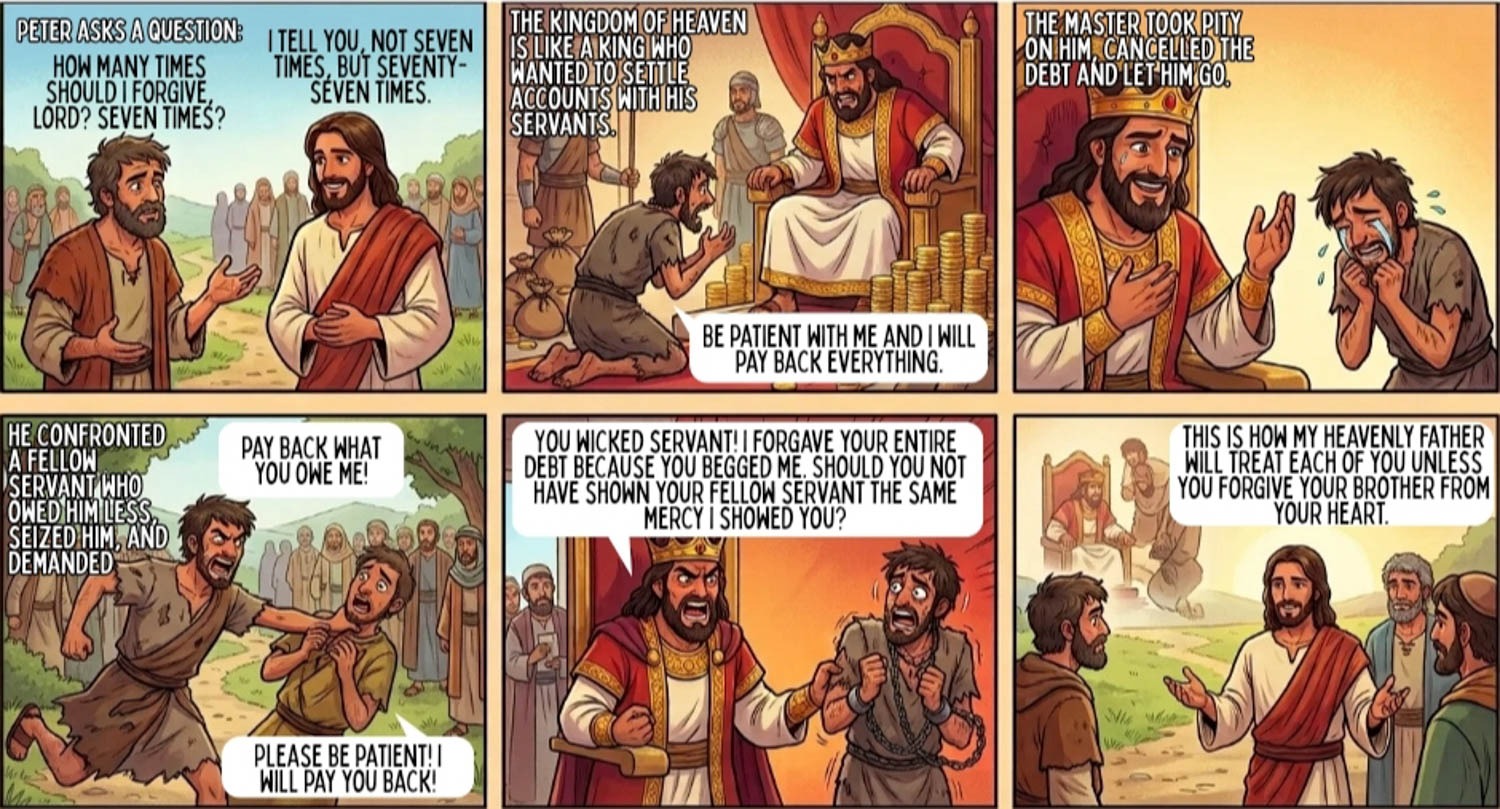
The dialogue between Jesus and Peter in Matthew 18:21-35 establishes divine mercy not as an exceptional concession, but as the foundational law of the Kingdom of God. When Peter offers to forgive seven times—a number already considered generous under rabbinic traditions—Christ surpasses these legalistic boundaries by commanding forgiveness “seventy-seven times” (or seventy times seven). Drawing from Sacred Tradition, St. Augustine connects this number to the 77 generations from Adam to Christ found in Luke’s genealogy, demonstrating that Jesus came to loose the sins of all generations. By fulfilling and perfecting the law through the Holy Spirit, Christ shifts humanity from a rigid ledger of human debts into the economy of grace, where the primary duty of the Church’s pastors and her faithful is unwearied, steadfast reconciliation.
This truth is vividly expressed in the Parable of the Unforgiving Servant, which serves as a solemn warning regarding the necessity of extending the mercy we receive. The first servant owes the king an immense debt of ten thousand talents —an amount impossible to repay, symbolizing humanity’s infinite debt to God incurred by sin. When the king, moved with compassion, remits the debt, he models the divine forgiveness later institutionalized in the Sacrament of Penance, where God absolves the penitent who approaches with a contrite heart. However, the forgiven servant’s subsequent refusal to pardon a minuscule debt owed by his fellow servant reveals a fatal spiritual blindness. As the Catechism of the Catholic Church teaches, our capacity to receive divine mercy is bound to our willingness to extend it; a heart that refuses to forgive closes itself off from the very grace it has received.
In daily life, this Gospel challenges us to live out the reality of the confessional, acting as faithful witnesses of Christ. Man frequently falls into the disposition of the unforgiving servant, seeking God’s boundless patience for himself while strictly accounting for the minor offenses of neighbors, coworkers, and family members. True Catholic charity does not imply the abdication of justice or the enabling of wrongdoing—right order and temporal consequences remain necessary for genuine correction—but it does demand the total eradication of malice and vengeance from the soul. Each time we faithful pray the Our Father, we petition God to measure His mercy toward us by the exact standard we apply to others; it is therefore necessary to release past grievances, dissolving resentment to live fully in the freedom of the children of God.
~ REV. FR. BRYAN MA. EALA, OSM
Learning to Forgive Through God’s Mercy
I used to wonder why some people find it difficult to forgive those who have hurt them. I thought, “Madali lang naman magpatawad.” But when I found myself in that situation, I realized that forgiveness is not always as easy as I once thought — especially when the person who hurt you is someone you deeply love, trust, and never imagined would cause you pain.
It is easy to say, “I’m sorry,” or “I forgive you.” But sometimes, even after the words have been spoken, the heart still aches. There are moments when the memories return, and you quietly ask yourself, “Kung napatawad ko na, bakit masakit pa rin?”
As I reflected on the Gospel, I realized that forgiveness is not a single moment. It is a journey, and sometimes, it is a prayer we have to offer again and again. There was a time when the weight in my heart became so heavy that I began distancing myself from others. I was afraid of hurting people again. I struggled to function, and even my commitments were affected. I thought I was simply tired, but no amount of rest could give me the peace I needed. Deep inside, I felt that my soul was asking for something more. I needed to return to the Lord.
I needed confession.
So, I went.
After receiving the Sacrament of Reconciliation, I felt something slowly becoming lighter within me. While praying my penance, I realized how many times the Lord had welcomed me back despite my mistakes and shortcomings. How many times had I asked Him for forgiveness, and how gently He had received me?
Then I realized: the Lord was also teaching my heart how to do the same.
I have been the one who needed mercy. I have also been the one who caused pain. And if God continues to meet me with compassion, I am being called to extend that same compassion to others.
Forgiveness does not mean pretending that nothing happened. It does not mean that the pain disappears overnight. Sometimes, forgiveness simply means placing the pain in God’s hands and saying,
“Lord, I am still hurting, but I choose to let You heal my heart.”
I want to learn to forgive—not because it is easy, but because I want to be free. Free from anger, resentment, and the wounds I have carried for so long.
And as I learn to forgive others, I am slowly discovering the beautiful truth that I, too, have always been held by the merciful heart of God.
~ Fred
PRAYER TO START THE WEEK
Lord, help us forgive those who have hurt us. When it is hard to let go, give us a gentle and understanding heart. Help us remember that we, too, have made mistakes and needed forgiveness. Thank You for always forgiving us and giving us another chance. Teach us to be patient, kind, and merciful toward others. May we share the same love and forgiveness You have shown us. Amen.
Originally published in the Neo Jeremiah Voice of the Young Prophet Newsletter (September 13, 2026 issue).