 Diocese of Parañaque

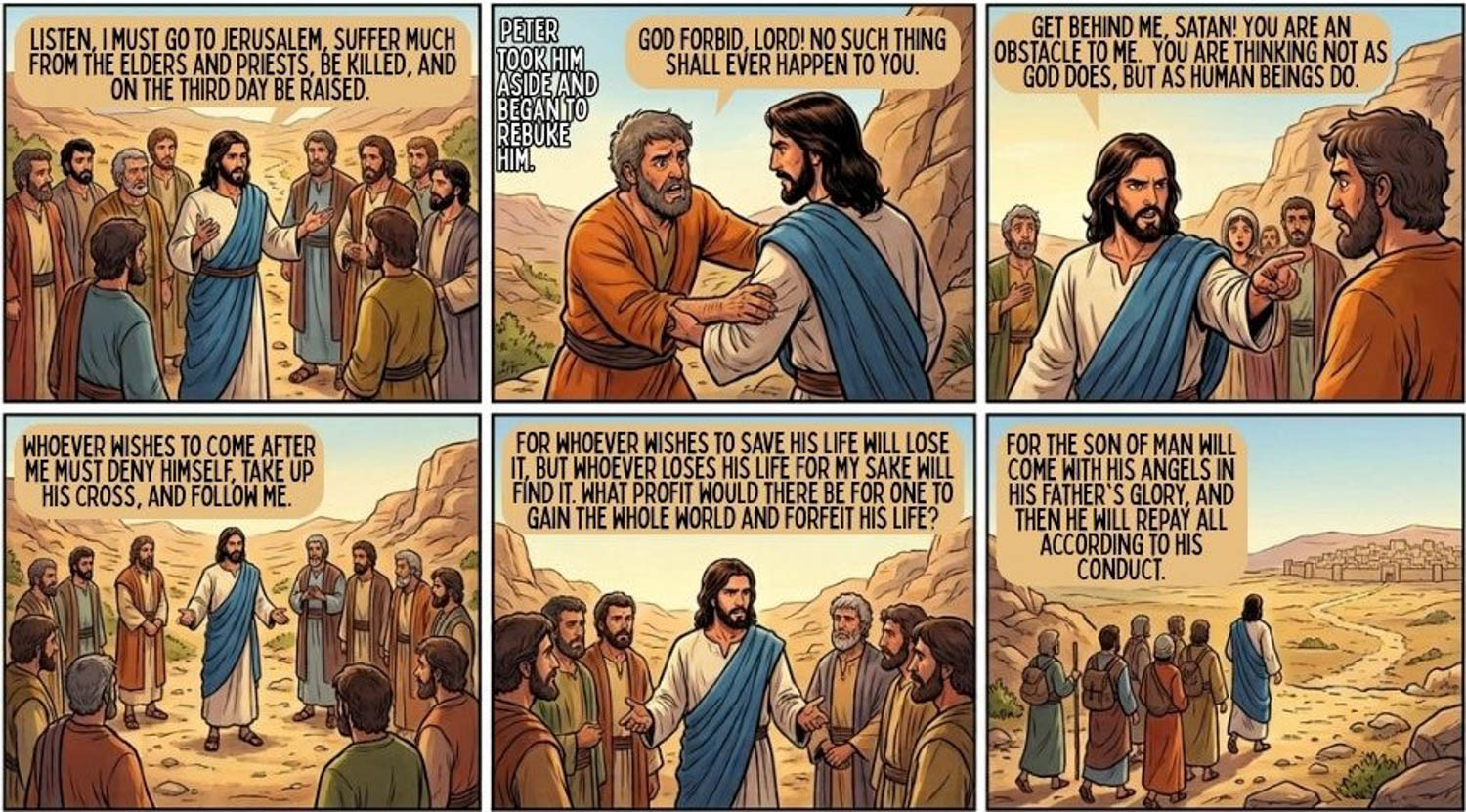
At the beginning of the Gospel, Jesus already predicts His upcoming suffering, death, and resurrection in Jerusalem. He also reveals his identity as the Messiah who will endure the suffering, while redefining true discipleship. Isn’t it that this is the will of the Father?
From the first moment of his Incarnation, the Son embraces the Father’s plan of divine salvation in his redemptive mission: ‘‘My food is to do the will of him who sent me, and to accomplish his work.’’ Indeed, the sacrifice of Jesus ‘‘for the sins of the whole world expresses his loving communion with the Father. Thus, the desire to embrace his Father’s plan of redeeming Love inspired Jesus’ whole life, for his redemptive passion was the very reason for his incarnation.
When Peter confesses that Jesus is the Christ. ‘‘From that time Jesus began to show his disciples that he must suffer in Jerusalem and suffer many things, and on the third day be raised’’ In other words, our Lord immediately begins to speak of the Cross. Once Peter confesses that he is the Christ, notice something profound here. We cannot separate Christ from the Cross; this is extremely profound the moment that Peter confesses that Christ is the Messiah. Jesus begins to speak about his suffering, death, and resurrection; we often call this the Paschal Mystery, and his ascension to the Father.
In Verse 22, what happened because Peter doesn’t understand the Cross? he said, “No, Lord, this must not happen to you’’ noticed how determined Peter is to keep Jesus from being crucified; he doesn’t understand how the Messiah, the anointed One, would be crucified, could be humiliated. And you know what? In Jerusalem, when one is found guilty of any crime, blasphemy, etc. either faces condemnation of the beast, Crucifixion etc., and Jesus was Crucified. The Cross is not just pain but a public humiliation. A cruel, degrading and obscene form of Roman punishment and execution, usually for slaves and non-citizens. Used as well for crimes against the Roman Empire- rebels and freedom fighters, sedition and high treason. Intent not only to torture and kill the criminal, but to shame and mock them, and to discourage people from following their example. This is exactly how our Christ endured and suffered on the Cross. Indeed, it is love ‘to the end’ that confers on Christ’s sacrifice its value as redemption, reparation, atonement, and satisfaction. He knew and loved us all when he offered his life. (CCC, 616)
In his plan of Salvation, God ordained that his Son should not only ‘‘die for our sins’’ but should also taste death, the separation of his soul from his body, between the time he expired on the cross and the time he was raised from the dead (CCC 624)
Characteristic of Christ’s suffering and death (CCC 563-573)
- Redemptive – his ultimate service in the Kingdom. Through his blood, God made him the expiation for all who believe.
- Redemption – to expiate the sins of the people.
- Redemption for us
- Jesus died because of human sinfulness
- He died to show us and empower us to overcome sin and its effects in our broken world.
Jesus’ violent death was not a result of chance in an coincidence of circumstances, but is part of Gods plan (CCC 599) The scripture had foretold of this divine plan of salvation through the putting to death of Jesus as a mystery of universal redemption, that is, as the ransom that would free men from slavery of sin (CCC 601) the redemptive death fulfills Isaiah’s prophecy of the suffering servant. Indeed, Jesus himself explained the meaning of his life and death in the light of God’s suffering servant. By his loving obedience to the Father, ‘‘un to death, even death on a cross’’ Phil 2:8, Jesus fulfils the atoning mission of the Suffering Servant of God, Isaiah 53:10. It is truly the Son of God made man who suffered, died and was buried. In his human soul united to his divine person, the dead Christ went down to the realm of the dead and opened heaven’s gate for the just who had gone before him.
The saying about taking up the cross connects the fate of the disciples with Jesus’ own fate. Verses 25-26 revolve around the theme of life and suggest that only in letting go of self and letting God do the guiding can we ever find freedom and happiness. He calls his disciples to ‘take up [their] cross and follow [him],’ for ‘Christ also suffered for [us] an example so that [we] should follow in his steps.’
~ REV. ARNOLD MA. TISUELA, OSM
Following Christ Beyond Comfort
Life often teaches us to pursue success, comfort, and security, believing that these are the things that will bring us lasting happiness. Yet the Gospel of Matthew 16:21-27 presents a different invitation from Jesus. Jesus begins to reveal to His disciples that He must suffer, die, and rise again. Peter, who genuinely loved Jesus, could not accept this reality and tried to prevent Him from going down that path. Yet Jesus corrected Peter, reminding him that God’s plans are far greater than human expectations and that discipleship is not about avoiding hardship but embracing God’s will.
As I reflect on these verses, I see a part of myself in Peter. There are many times when I prefer comfort, security, and certainty. Like him, I struggle when life does not unfold according to my plans. I often pray for easier roads, quicker solutions, and fewer challenges. Yet Jesus reminds me that following Him is not about choosing the most comfortable path but trusting Him even when the journey is difficult and unclear.
The verse that speaks most deeply to me is Matthew 16:26: “What good will it be for someone to gain the whole world, yet forfeit their soul?” In a world that often measures success by achievements, recognition, wealth, and status, this question invites me to examine my priorities. It challenges me to ask myself what truly matters at the end of the day. No accomplishment can compare to a life lived in communion with God. The greatest success is not what I gain for myself, but how faithfully I love, serve, and follow Him.
This message became even more meaningful during our recent team-building activity. Surrounded by colleagues, away from the usual pressures of work, I was reminded that life is about more than deadlines, targets, and achievements. The laughter, conversations, shared experiences, and genuine connections we built reminded me of what truly matters. For a moment, work goals took a back seat, and I realized how easy it is to become focused on performance and productivity while neglecting relationships, personal wellbeing, and spiritual growth. Jesus’ question echoed in my heart: What good is success if I lose sight of the things that give life its deepest meaning?
Jesus’ suffering ultimately led to the victory of the Resurrection. Through His example, I am reminded that God can bring purpose from sacrifice, growth from challenges, and hope from difficult seasons. Following Christ means trusting that even when I do not understand His plans, He is leading me toward something greater than I can see.
~ M’JENN
PRAYER TO START THE WEEK
Lord Jesus, help us to follow You faithfully, even when the path requires sacrifice and courage. Teach us to deny ourselves, carry our crosses with trust, and place Your will above our own. May we never lose sight of Your Resurrection, knowing that every cross carried with faith leads us closer to You. Amen.
Originally published in the Neo Jeremiah Voice of the Young Prophet Newsletter (August 30, 2026 issue).